Performance
Version 6 replaces the HtmlAgilityPack-based v5 engine with an AngleSharp HTML5 parser feeding a purpose-built Markdown DOM and per-flavor writers. Beyond being more correct, the new pipeline is substantially faster and allocates far less memory.
Results
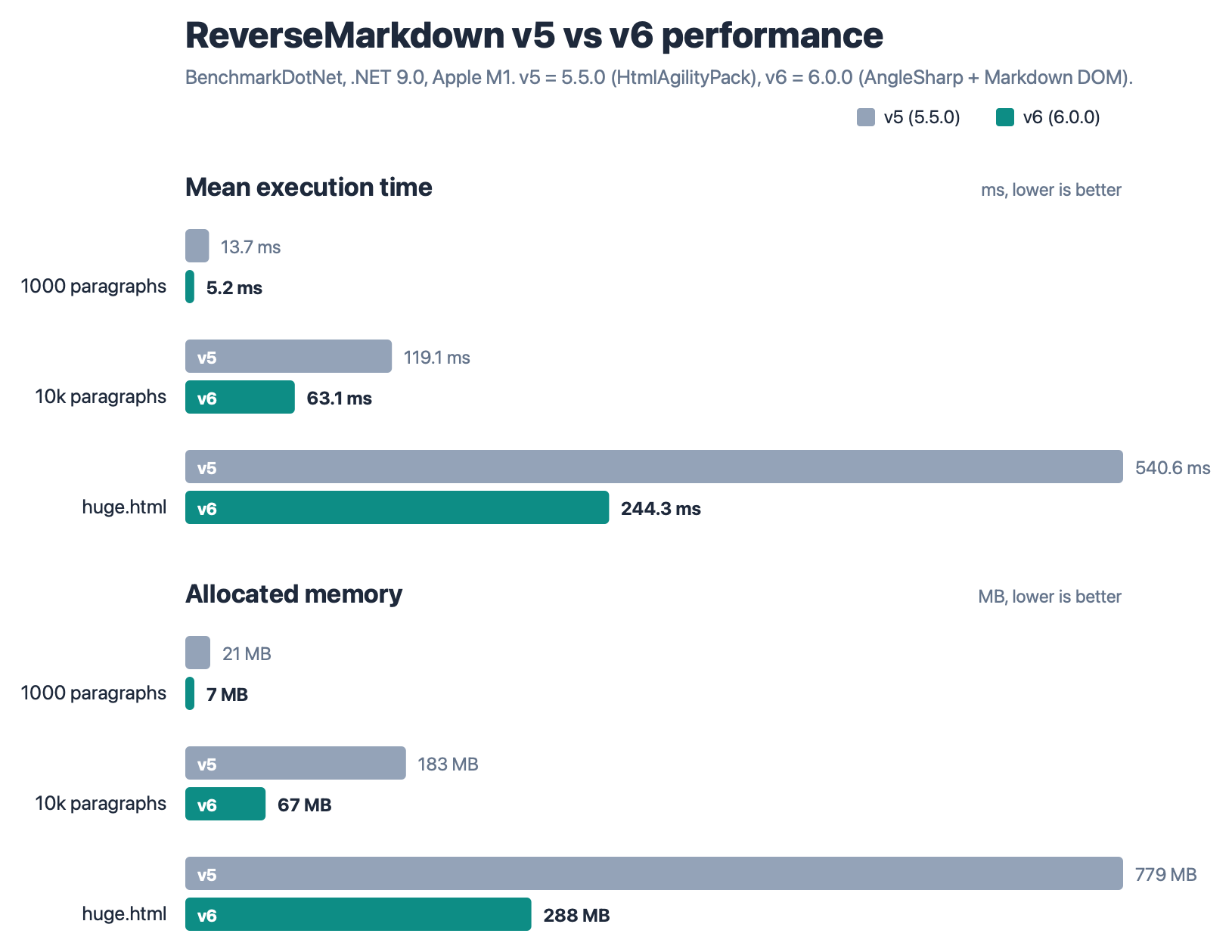
Measured with BenchmarkDotNet on .NET 9.0 (Apple M1), comparing the published ReverseMarkdown 5.5.0 (HtmlAgilityPack) against 6.0.0 (AngleSharp + Markdown DOM) on the same inputs. Lower is better.
| Fixture | Mean time v5 → v6 | Allocated v5 → v6 |
|---|---|---|
| 1000 paragraphs | 13.7 → 5.2 ms (2.6× faster) | 21 → 7 MB (2.8× less) |
| 10k paragraphs | 119.1 → 63.1 ms (1.9× faster) | 183 → 67 MB (2.7× less) |
| huge.html | 540.6 → 244.3 ms (2.2× faster) | 779 → 288 MB (2.7× less) |
Across the board v6 runs roughly 2–2.6× faster and allocates about 2.7× less memory. The memory reduction is the bigger practical win: less GC pressure keeps throughput steady when converting large documents or many documents concurrently.
6.3.0: real-world pages
The v5 vs v6 comparison above uses synthetic paragraph fixtures. Version 6.3.0 was measured on a corpus of real pages instead (Wikipedia articles, framework documentation and MDN pages from the mdream project), which is where it found its main fix: the cleanup pass that handles unclosed <script> and <style> tags copied the rest of the document once per tag, so pages with many of them paid for it on every conversion. That pass is now linear.
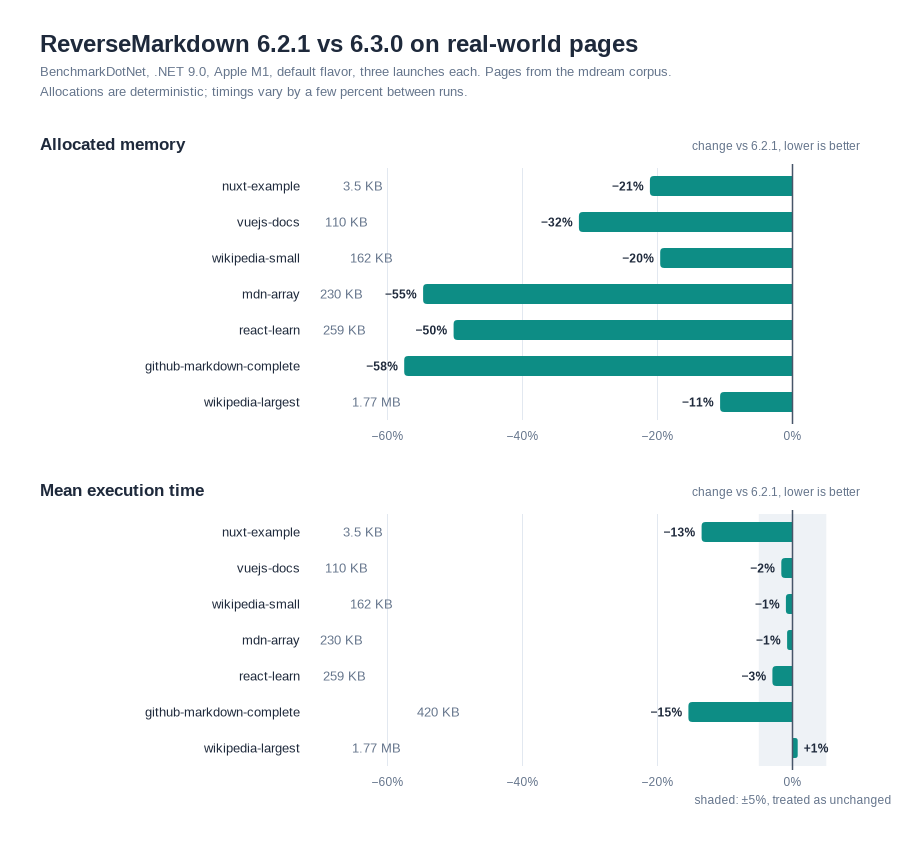
Published 6.2.1 against 6.3.0, default flavor, .NET 9.0 on an Apple M1, three launches each. Lower is better.
| Fixture | Size | Mean time 6.2.1 → 6.3.0 | Allocated 6.2.1 → 6.3.0 |
|---|---|---|---|
| nuxt-example.html | 3.5 KB | 72.7 → 62.9 μs (-13%) | 133.9 → 105.6 KB (-21%) |
| vuejs-docs.html | 110 KB | 4.39 → 4.32 ms (-2%) | 4.82 → 3.30 MB (-32%) |
| wikipedia-small.html | 162 KB | 7.49 → 7.42 ms (-1%) | 7.70 → 6.19 MB (-20%) |
| mdn-array.html | 230 KB | 9.77 → 9.69 ms (-1%) | 17.68 → 8.00 MB (-55%) |
| react-learn.html | 259 KB | 10.32 → 10.01 ms (-3%) | 13.99 → 6.97 MB (-50%) |
| github-markdown-complete.html | 420 KB | 11.57 → 9.79 ms (-15%) | 24.68 → 10.48 MB (-58%) |
| wikipedia-largest.html | 1.77 MB | 175.1 → 176.4 ms (+1%) | 222.5 → 198.6 MB (-11%) |
Allocations drop on every page, by about half on the script-heavy ones. Time improves clearly on github-markdown-complete (-15%) and nuxt-example (-13%). Every other page is within ±3%, which is inside run-to-run noise, so read those as unchanged in speed. Fewer allocations still mean less garbage-collection work, which adds up when a service converts many documents.
6.3.0 also adds TextWriter overloads, which lower peak memory further by skipping the full-size output string.
Reproducing the benchmarks
The benchmark lives in src/ReverseMarkdown.Benchmark. By default it references the published NuGet package, so you can swap the version between runs to compare releases:
# v6 (default)
dotnet run -c Release --project src/ReverseMarkdown.Benchmark

# v5, for comparison
dotnet run -c Release --project src/ReverseMarkdown.Benchmark -p:RMVersion=5.5.0
To measure your local working tree instead of a published package, which is what you want when checking whether a change helped, add -p:UseLocalReverseMarkdown=true.
The real-world corpus is third-party content, so it is not committed. Fetch it once, then run either a quick throughput summary or the full BenchmarkDotNet run:
./scripts/fetch-benchmark-corpus.sh

# Quick summary in MB/s of input HTML, per size group (takes seconds)
dotnet run -c Release --project src/ReverseMarkdown.Benchmark -- throughput

# Full BenchmarkDotNet run over the corpus, with allocations per fixture. Three launches
# (separate processes) so the reported error includes launch-to-launch variance.
dotnet run -c Release --project src/ReverseMarkdown.Benchmark -- --filter '*Corpus*' --launchCount 3
Numbers vary with hardware and runtime; compare runs made on the same machine. BenchmarkDotNet's error column covers only the launches it ran, so a single launch understates the variance between runs; that is what --launchCount 3 is for. Allocations need no repeats: they are identical on every run.